
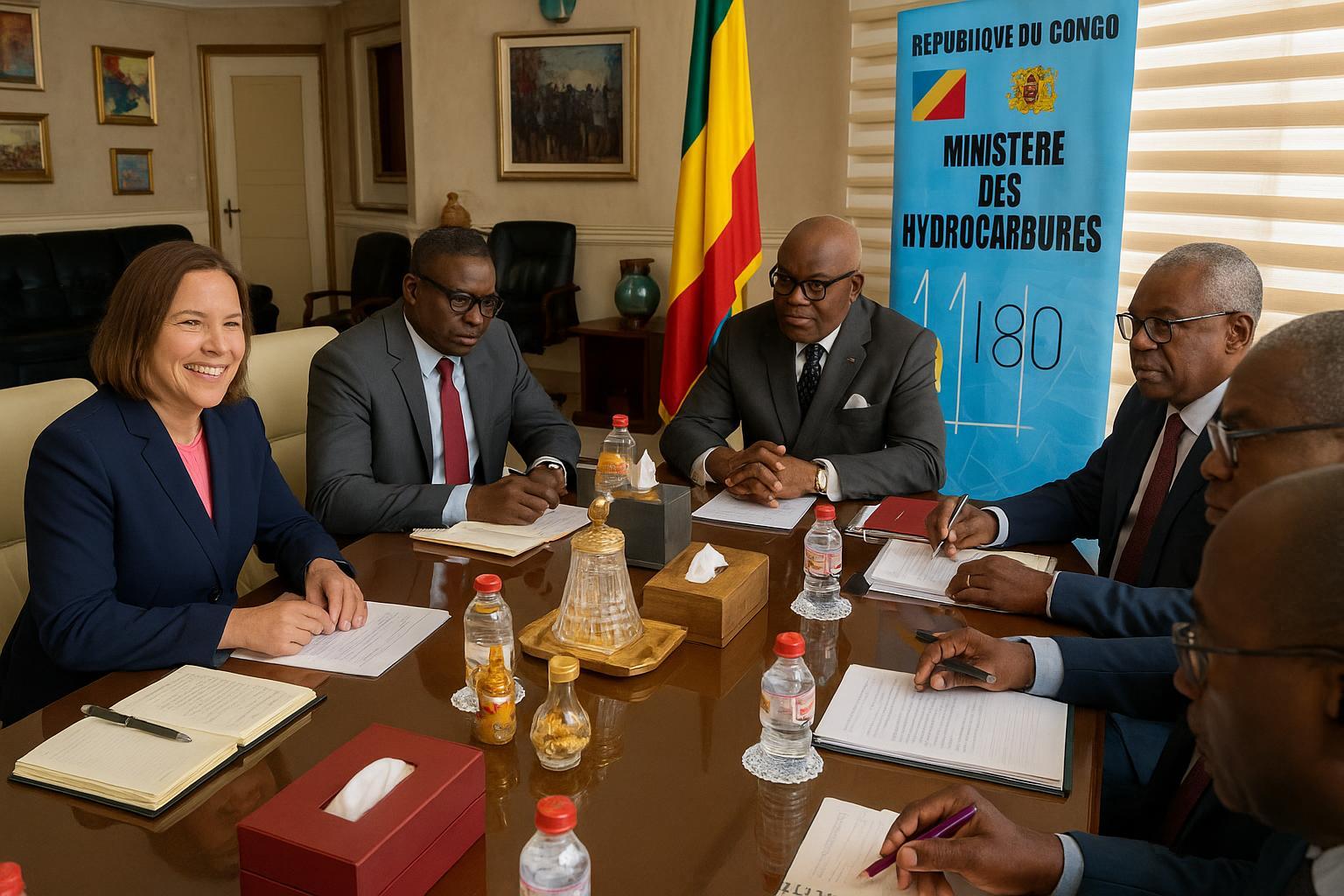
Diplomatic momentum grows
Brazzaville’s marble-floored Hydrocarbons Ministry hosted an animated exchange on 25 November. Minister Bruno Jean Richard Itoua and U.S. chargé d’affaires Amanda Jacobsen reviewed what both sides called “promising openings” for new petroleum and natural-gas ventures, reinforcing a partnership stretching back more than three decades.
Jacobsen told reporters the dialogue was “productive and forward-looking”, underlining Washington’s wish to see additional U.S. capital flow into Congo’s energy market. According to the U.S. Embassy, energy already represents the largest bilateral business link, yet officials believe untapped acreage can still attract world-class operators.
The minister welcomed the overture, stressing that Congo’s business framework has been streamlined to accelerate field approvals and protect investors. He added that President Denis Sassou Nguesso personally encourages diversification of partners so the national economy gains resilience against oil-price swings.
A legacy of American rigs
Chevron, Kosmos Energy and several mid-size service firms have been active off Congo’s coast since the mid-1990s, contributing royalties, training and technology transfers, the Ministry’s public data show. Their platforms helped lift national crude output above 300,000 barrels per day during peak years.
Observers note that the United States became a key source of deep-water know-how after France’s TotalEnergies led the first offshore wave. Jacobsen said this history offers “a trusted springboard” for broadening cooperation into gas monetisation, petrochemicals and carbon-capture solutions.
Energy analyst Jules Koumba of Pointe-Noire University adds that American companies often pioneer horizontal drilling and digital well management, techniques Congo wants to replicate onshore. “Local engineers can gain hands-on experience without leaving the country,” he explained.
From subsalt to tierra-firma
Talks reportedly examined the Marine XXI block off Kouilou and untapped gas pockets near Nkayi. While details remain confidential, Itoua confirmed interest from Continental Resources, the Oklahoma City independent that met President Sassou Nguesso in September. It specialises in recovering waxy crudes similar to those found in Congo.
Industry sources say feasibility studies could start early next year, combining 3D seismic re-processing with satellite imagery to refine drilling targets. The Ministry expects first investment decisions before 2026 if commercial volumes are confirmed.
Onshore, the Cuvette Basin is drawing attention after last year’s discovery by local firm SARPD-OIL. U.S. players are evaluating joint-venture terms that would fast-track appraisal wells while boosting local procurement, officials familiar with the dossier indicate.
Jobs, skills and community spin-offs
Every additional rig creates jobs for roughnecks, welders, safety officers and catering crews. The National Employment Office estimates that each offshore project supports roughly 1,200 direct and indirect posts throughout its lifecycle.
Jacobsen highlighted Congo’s Local Content Act, which reserves at least 30 percent of service contracts for domestic firms. “That aligns with American companies’ pledge to hire and train locally,” she said, adding that scholarships in petroleum engineering could be expanded at Marien Ngouabi University.
Minister Itoua pointed to Pointe-Noire’s Industrial Service Centre, jointly funded by ExxonMobil and the government, as evidence that skill-building is already paying dividends. He urged new entrants to replicate the model in inland departments where oil activity is nascent.
Balancing barrels and carbon
Congo ratified the Paris Agreement and recently launched the Fally Forest Carbon Initiative encompassing two million hectares. Officials insist fresh drilling must respect strict environmental impact rules and incorporate gas-flaring reduction devices.
American firms advertise emission-cutting technologies developed in shale basins. Jacobsen cited closed-loop gas systems and real-time methane monitoring as tools that could be deployed in Congolese fields. “Energy security and climate goals can walk hand in hand,” she argued.
Environmental economist Thérèse Okemba agrees, noting that associated gas harnessed for power plants could strengthen the national grid and reduce diesel imports. She sees scope for a new public-private taskforce to track sustainability metrics.
Roadmap to final investment
Technical teams from both governments will meet again in February to update the bilateral memorandum on energy cooperation, officials confirmed. Draft annexes cover fiscal incentives, dispute-resolution mechanisms and data-sharing protocols.
Analysts at Brazzaville brokerage Atlantique Finance believe global oil demand will stay robust through 2030, giving Congo a favourable window to sanction projects while prices remain above 80 dollars per barrel. They note that shipping lanes from Pointe-Noire allow flexible exports to Atlantic and Asian buyers.
For commuters and small businesses alike, the stakes are tangible. Stable production secures fuel supplies, forex earnings and budget revenue that fund roads, schools and health centres. As Jacobsen concluded, the shared objective is “more barrels, more jobs and more light in Congolese homes.”