
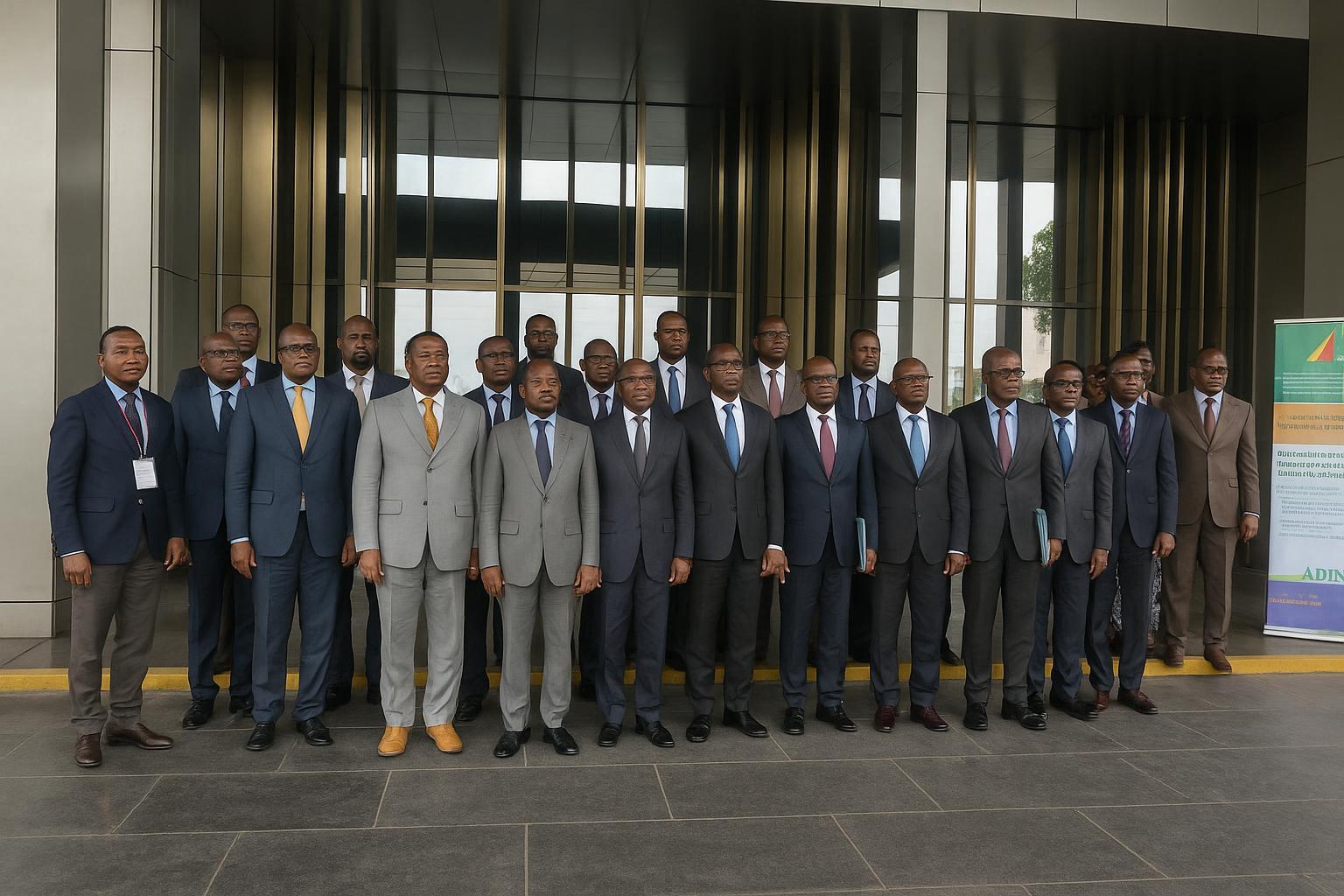
Kintélé workshop seals historic accounting shift
A quiet room at the Kintélé International Conference Center became the stage for a landmark decision. Under the Programme for the Acceleration of Institutional Governance and Reforms, finance officials, sector experts and development partners agreed on a fresh set of accounting rules for the Congolese state.
The three-day session, chaired by Finance and Budget Minister Christian Yoka, ended with unanimous approval of a reference document that will guide the way ministries, local authorities and public hospitals record every franc of public money.
Fourteen standards, one transparent language
The new framework, described by delegates as “fourteen pillars”, aligns procedures that were previously scattered across different decrees. Saturnin Ipodo-Nzingou, Director-General of Public Accounts and State Assets, told reporters the norms define how assets and liabilities will be measured, disclosed and consolidated in a single national ledger.
He stressed that a shared vocabulary is essential: “These are principles everyone can trust to guarantee the quality of the financial information we produce.”
From universities to health centres, who is affected?
The standards will apply to the central government, departments, municipal councils and public bodies that receive transfers from the state budget. That list ranges from Brazzaville’s Marien-Ngouabi University to Denis-Sassou-Nguesso University in Kintélé and general hospitals across the country.
Each entity will now present its accounts in a harmonised format, making it easier for both auditors and citizens to follow the flow of public funds.
Why timing matters for Brazzaville
Approval comes as Congo-Brazzaville intensifies cooperation with multilateral lenders. The International Monetary Fund and the World Bank have repeatedly called for clearer fiscal data before unlocking concessional loans. By validating the norms, the government sends what officials call “a confidence signal” to those institutions.
Minister Yoka noted that the move dovetails with annual budget laws, ensuring every revenue, expenditure and resulting asset is traced with precision.
Link with the 2024 state chart of accounts
Last year the same actors unveiled a revamped plan comptable de l’État, listing every possible transaction code. The freshly validated norms form the legal backbone of that chart, outlining not only what line items exist but also how they must be valued and reported.
Taken together, the two documents form a modern accounting architecture designed to survive future economic shocks.
Expert focus on assets and liabilities
Delegates spent hours debating the valuation of infrastructure built under public-private partnerships, a topic growing in importance as Congo expands its road network. They agreed on prudent recognition methods to avoid over-statements that could mislead decision makers.
Another sensitive point was the classification of arrears, a legacy issue dating back more than a decade. The standards now require full disclosure, a step experts regard as key to long-term debt sustainability.
Strengthening internal and external audits
By codifying procedures, the government expects to streamline the work of internal auditors in each ministry. External oversight bodies, including the supreme audit institution, will also gain a consistent benchmark when reviewing accounts.
“If everyone speaks the same accounting language, audit cycles shorten and recommendations gain weight,” commented a Pagir technical adviser during the workshop’s closing session.
Digital tools on the horizon
Although the workshop focused on rules, discussions frequently veered toward technology. Officials acknowledged that implementing real-time reporting systems will be crucial to applying the norms uniformly.
The Finance Ministry’s IT division is drafting specifications for software capable of integrating payroll, procurement and treasury data into one platform, delegates confirmed after the final plenary.
Training as the next critical step
Rolling out the standards to hundreds of accountants nationwide will require a robust capacity-building plan. The Pagir secretariat is preparing a cascade model: train central trainers first, then send them to provinces from Pointe-Noire to Ouesso.
Initial sessions are due to begin once the decree enacting the norms is published in the official gazette, a move expected “in the coming weeks”, according to ministry sources.
Budget discipline and citizen trust
Civil-society observers argue that transparent accounts strengthen social cohesion by giving taxpayers a clearer picture of how public money finances schools, roads and clinics. Officials agree that improved trust can translate into higher domestic revenue collection.
“Citizens deserve to see value for money, and these norms will help,” Ipodo-Nzingou affirmed.
Financial partners welcome the advance
Preliminary reactions from technical partners indicate strong support. An IMF mission that visited Brazzaville earlier this year highlighted the need for “comprehensive, timely budget execution data”. The new norms answer that call, a senior Fund economist noted in a memo shared with local media.
World Bank staff involved in governance projects also signalled readiness to back training and digitalisation components once the rollout budget is finalised.
Legal process and timeline
After validation, the document moves to the Council of Ministers for formal adoption. A presidential ordinance will then give it binding force. Ministries must align their internal manuals within six months, while state-owned enterprises will receive a grace period before convergence.
Pagir officials say progress will be reviewed quarterly, with public scorecards to keep momentum high.
Smooth cooperation across ministries
One notable feature of the Kintélé workshop was strong inter-ministerial coordination. Representatives from Health, Higher Education, Infrastructure and Interior all took part, ensuring sector-specific concerns were captured.
Observers say such collaboration is essential to avoid parallel systems emerging and maintain a single source of fiscal truth.
Socio-economic ripple effects
Economists point out that transparent state accounts can lower the country’s risk premium, potentially reducing borrowing costs and freeing resources for social programmes. Over time, better data can guide infrastructure choices that maximise inclusive growth.
While these benefits may take years to materialise, the legal foundation laid in Kintélé is a first and indispensable step.
Continued political commitment
Participants credited high-level support for the project’s momentum. Minister Yoka’s presence throughout the workshop signalled the government’s determination to elevate public-sector governance among national priorities.
That commitment aligns with President Denis Sassou Nguesso’s broader vision of modernising institutions while safeguarding macro-economic stability.
Voices from local administrations
Municipal finance directors attending the event appreciated the clarity the norms bring. “We will finally have guidance on depreciating community assets like markets and water points,” said a Brazzaville city accountant, adding that uniform rules will aid inter-city comparisons.
Their feedback will be integrated into the final implementation guide, organisers confirmed.
Monitoring, evaluation and future updates
Pagir’s governance unit plans to establish a monitoring dashboard with indicators such as the percentage of entities filing accounts on time and the share of transactions recorded electronically.
Annual reviews will allow adjustments, ensuring the framework remains aligned with evolving international public-sector accounting standards.
A decisive milestone toward open finances
With fourteen comprehensive standards now validated, Congo-Brazzaville has moved from discussion to action on financial transparency. Implementation will require discipline, but the legal compass is set.
As the decree enters into force, citizens, investors and partners alike will watch how effectively this new accounting language is spoken across the Republic.