
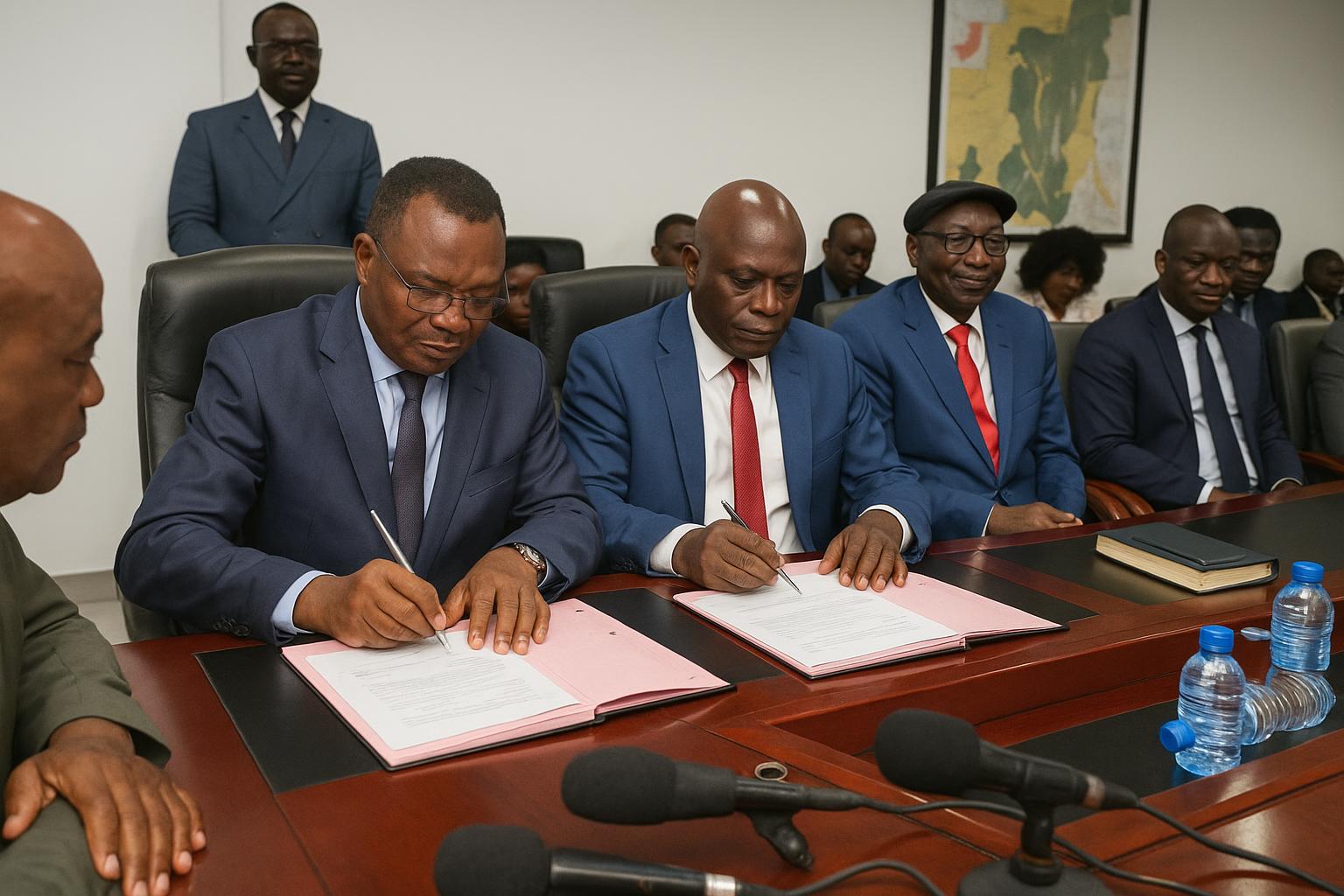
Strategic media-business alliance in Brazzaville
Brazzaville’s Marriott Riverfront ballroom hummed with cautious optimism as Paul Nestor Mouandzibi, president of the Congrès des chefs d’entreprise du Congo, and Anasth Wilfrid Mbossa, head of La Nouvelle République, inked a partnership designed to spotlight private sector dynamism.
Signed under the attentive gaze of Communication Ministry chief-of-staff Antoine Oviebo-Ethaï, the accord binds Congo’s largest employers’ congress and its historic state-owned media outlet in a bid to craft uplifting narratives about entrepreneurship and, by extension, national modernization ambitions.
Communicating Opportunity to a Wider Audience
Mouandzibi insisted that economic reform can falter without persuasive storytelling. “Investors respond to clarity,” he told reporters, noting that many promising firms remain invisible beyond district borders because they lack consistent coverage from trusted platforms.
The partnership stipulates regular multimedia features on start-ups, export-ready manufacturers and agritech innovators. Content, the two leaders agreed, will highlight compliance with domestic regulations and showcase success stories that align with the national Development Plan 2022-2026 (official communiqué, 27 August).
Communication specialists from the École Supérieure de Gestion in Brazzaville will mentor CCEC spokespeople on framing data in digestible formats, an initiative partly financed by the French Development Agency and slated to start courses next quarter.
Inside the CCEC’s Expanding Mandate
Founded in 2001, the CCEC convenes more than 600 enterprises ranging from mining majors to fintech pioneers, giving it leverage when negotiating taxation or customs frameworks with ministries.
Its policy unit recently proposed a one-stop licensing window that, according to internal briefs seen by the magazine, could cut business registration time from forty days to ten, a measure now under review by the Prime Minister’s office.
La Nouvelle République in the Digital Age
Created through a 1998 merger of legacy dailies, La Nouvelle République retains the broadest terrestrial reach in Congo-Brazzaville, printing 35,000 copies daily while feeding content to an FM radio chain and an online television channel.
The newsroom’s recent pivot toward data journalism impressed advertisers who, Mbossa said, “seek audience metrics as rigorously as auditors examine ledgers.” Investments in cloud editing suites and mobile reporting kits are financed partly by state allocations and partly by subscription revenue.
A forthcoming mobile application, now in beta testing, will push news alerts on procurement tenders and tax incentives directly to entrepreneurs’ smartphones, bridging what Mbossa calls a ‘last-mile information gap’ between government circulars and small business owners in rural districts.
Official Encouragement and Policy Context
By attending the signing, the Communication Ministry signaled alignment with President Denis Sassou Nguesso’s directive to ‘mobilize all channels for growth advocacy’, issued during the July cabinet retreat (government bulletin).
Officials argue that positive coverage of indigenous enterprises can shore up domestic confidence and reduce dependence on imported consumer goods, objectives echoed in the ‘Made in Congo’ labeling decree enacted last year.
Economist Émilie Abena believes the media-business link is timely, noting that non-oil GDP rose 5.7 percent in 2022 yet still struggled for recognition abroad. ‘Visibility converts figures into credibility,’ she said in a telephone interview.
The Ministry of Small and Medium Enterprises is preparing a dashboard that will aggregate metrics captured by La Nouvelle République, enabling policymakers to track job creation and export volumes generated by showcased firms, according to departmental notes shared with our newsroom.
Regional and International Reach
Under the agreement, La Nouvelle République will syndicate select reports to pan-African newswire APA News and francophone broadcasters in Dakar and Abidjan, widening the corridor for Congolese brands to court investors on the continent.
The CCEC will reciprocate by hosting annual roadshows in Paris and Dubai, events at which correspondents are guaranteed accreditation, enhancing real-time coverage of deal signings and market briefings.
International public relations agency Havas Africa is expected to advise on cross-border messaging to ensure that language nuances resonate in both anglophone and lusophone markets, a move observers say could attract diversified financing streams beyond traditional French-speaking partners.
Balancing Editorial Independence
Asked about potential conflicts of interest, Mbossa emphasized that editorial charters remain intact and that branded segments will be clearly flagged to readers, a practice consistent with international standards endorsed by the World Association of Newspapers.
Mouandzibi added that companies profiled must allow journalists to inspect production sites and social-impact data before any story airs, ensuring factual balance while preserving corporate confidentiality where required by law.
Analyst Joseph Mankoko concludes that such safeguards, if upheld, could create a virtuous loop: transparent enterprises win consumer trust, the media gains audience loyalty, and policymakers receive tangible proof of progress toward diversification targets set in the Emerging Congo 2030 blueprint.
Civil society organizations, including the Congolese Union of Consumers, welcome the transparency clauses but urge that environmental and labor standards also occupy airtime. Their president, Angélique Makosso, said she hopes future broadcasts will ‘celebrate profit that respects people and planet alike.’ She offered to supply audit data for upcoming features.