
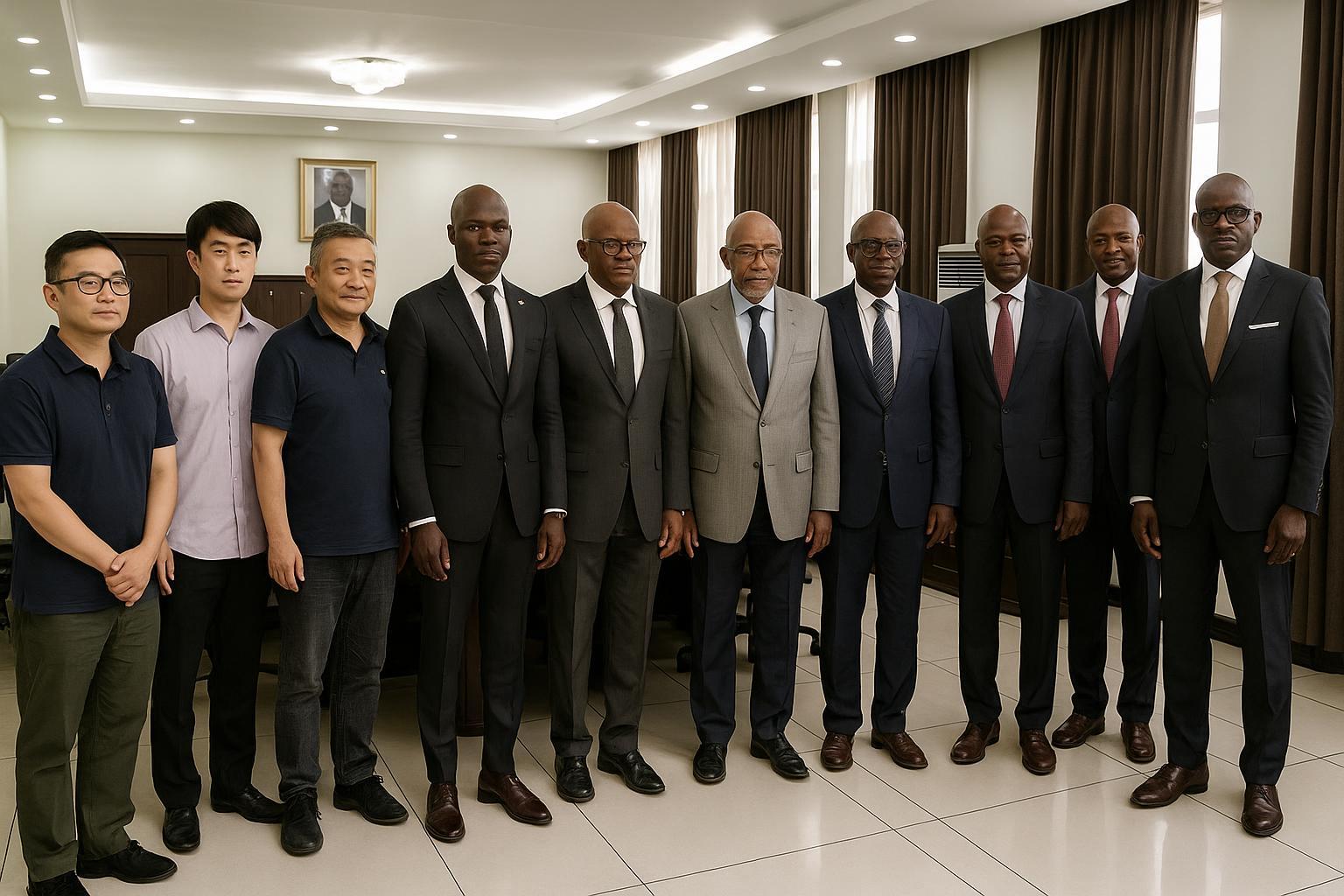
Congo-China industrial partnership gathers momentum
Brazzaville has witnessed a new chapter in Sino-Congolese cooperation as engineers from Guangdong walked factory floors beside Congolese technicians this week. Their mission is simple: translate years of Chinese large-scale food processing experience into practical skills for local producers.
The visible face of this partnership is Sofatt Industrie, a home-grown company known for bottled juices, yogurts and mineral water. Backed by a 1.5-billion-CFA investment package, the firm plans to break ground on a modern plant in the coastal city of Pointe-Noire.
Officials consider the venture a pilot for wider agro-industrial growth envisioned under the National Development Plan 2022-2026, which earmarks manufacturing as a pillar of economic diversification (Ministry of Economy data, 2023).
China now ranks as Congo’s top bilateral investor, with cumulative commitments above 6 billion dollars across mining, infrastructure and agriculture, data compiled by the Economic Commission for Africa show. Agro-processing, however, represents less than 4 percent of that portfolio, leaving ample room for growth.
Sofatt Industrie’s Pointe-Noire blueprint
Chief executive Lassina Ouattara told reporters that site preparation will start early 2024 after geotechnical studies confirmed soil stability near the Atlantic port. He expects construction to reach mechanical completion within eighteen months, creating 150 direct jobs and roughly 500 indirect opportunities, and community housing plans are already drafted.
Output forecasts suggest a daily capacity of 120,000 beverage units and 20,000 yogurt cups, volumes that could substitute a meaningful share of imports currently sourced from Cameroon and Europe, according to customs tallies reviewed by the Congolese Shippers Council.
Pointe-Noire’s deep-water harbor and its connection to the Congo-Ocean Railway were cited by Chinese project leader Wang Xuefeng as “decisive logistical assets that shorten supply chains and reduce landed cost”, remarks captured by national television channel Télé Congo.
Technology transfer and workforce upskilling
Under the cooperation protocol signed in Guangzhou in 2021, Sofatt technicians attend three-month residencies in Chinese plants to master aseptic filling, preventive maintenance and quality control regimes compliant with ISO 22000 standards (China Council for the Promotion of International Trade, 2022).
The first cohort of twenty trainees returned to Brazzaville this July and is now replicating procedures on pilot equipment installed inside the existing Kintélé facility, reducing reject rates by 12 percent within eight weeks, internal dashboards seen by this magazine indicate.
Human-capital expert Professor Clarisse Mabiala of Marien Ngouabi University argues the model could cut skill gaps that often delay industrial ramp-up. “Spending on machinery is only fruitful if operators can fine-tune it in real time,” she noted during a policy forum on Wednesday.
Government’s enabling framework for private sector
Meeting the delegation on 19 August, Minister of Industrial Development Antoine Thomas Nicéphore Fylla Saint-Eudes reiterated that Sofatt will benefit from tax incentives available under Law 14-2016 on Special Economic Zones, including customs rebates on imported capital goods.
Director-General of Industry Wilfrid Adolphe Milandou later told the press that a one-stop licensing window has been created to accelerate land titling, environmental clearance and utility hookups, trimming administrative processing time to ninety days, down from an average of ten months in 2019.
Policy consistency is crucial, stresses economist Jean-Baptiste Ngombale, pointing to earlier horticulture ventures that stalled once concession agreements lapsed. He, however, applauds the current alignment between fiscal stimuli and the Pan-African Continental Free Trade Area, which could open new export lanes.
Regional economic ripple effects
Analysts at the Central African Economic and Monetary Community believe the Pointe-Noire factory could stimulate upstream demand for sugarcane, citrus and dairy inputs, offering farmers predictable offtake contracts and reducing post-harvest losses, currently estimated at 30 percent in coastal provinces.
Logistics operators equally foresee additional container throughput, as beverage concentrate imports flow in and finished products move out. The port authority projects incremental traffic of 8,000 TEUs per year, a modest yet steady rise that aligns with its expansion masterplan.
Job creation could also have social dividends. Sociologist Diane Koumba notes that steady factory wages in urban areas tend to lower informal migration to Brazil and the Gulf, a trend documented in last year’s national diaspora survey financed by the International Organization for Migration.
Roadmap to 2026 and beyond
Construction contracts are expected to be awarded by December, with Chinese engineering firms competing alongside regional contenders from Gabon and Côte d’Ivoire, insiders say. Tender documents emphasize environmental safeguards such as wastewater recycling and solar-assisted boilers.
Financiers appear confident. Banque Postale du Congo has committed 40 percent of the required credit line, while China EximBank is conducting due diligence on the remaining tranche, according to two bankers familiar with the talks who requested anonymity.
If timelines hold, commercial production could start in January 2026, in sync with the government’s industrial scoreboard. For Minister Fylla Saint-Eudes, the message is clear: “Partnerships that blend capital, skills and markets are no longer optional; they are the engine of resilience.”