
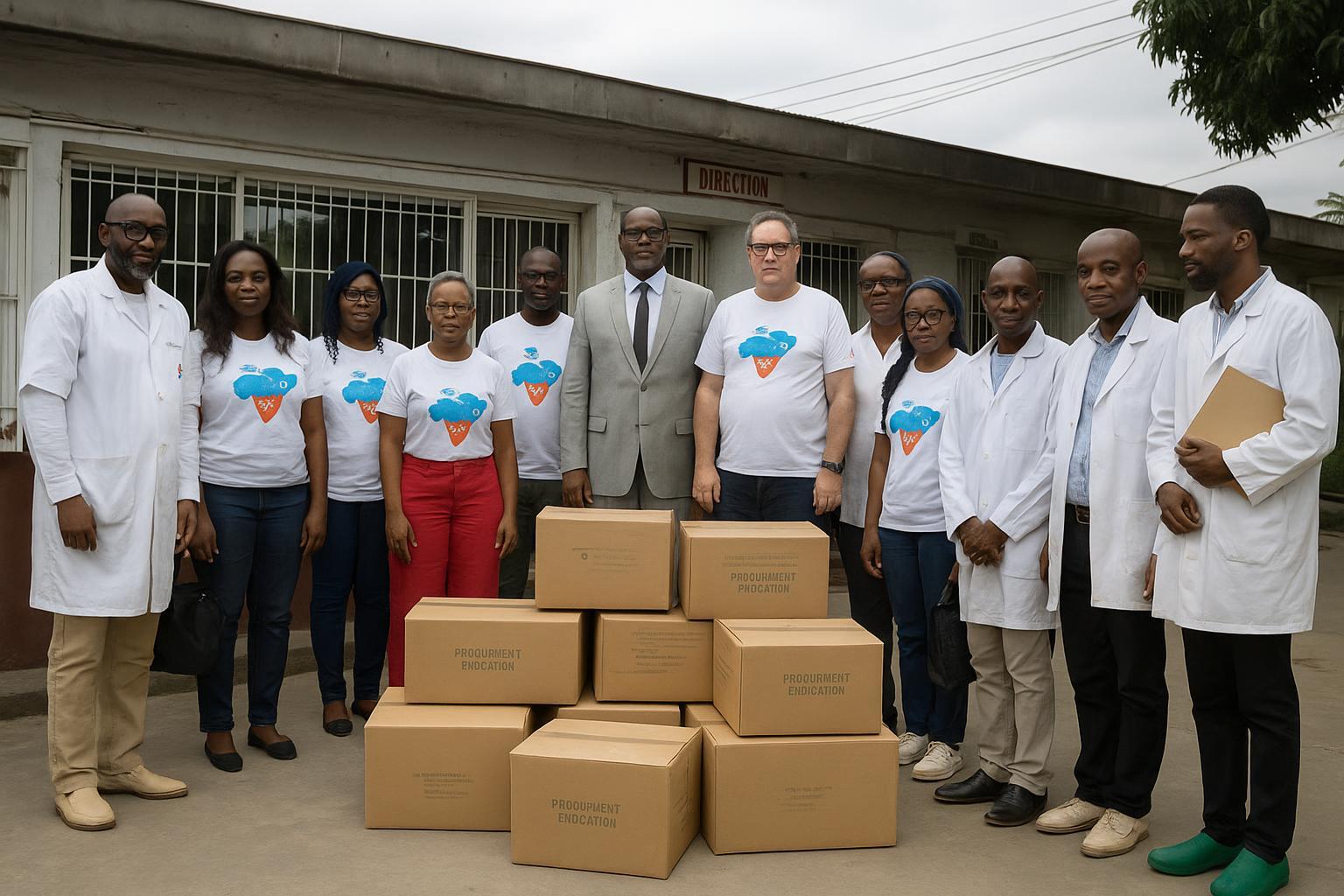
Corporate solidarity fuels health drive
A steady blood supply can mean the difference between life and death in emergencies. Africa Global Logistics, working through its Congolese subsidiaries AGL Congo, Congo Terminal and Terminaux du Bassin du Congo, has stepped forward with 2 500 double blood bags for the National Blood Transfusion Centre.
The bags, handed over this week in Brazzaville, will be dispatched to collection teams across the country. CNTS technicians say each double bag safely separates red cells and plasma, doubling therapeutic options for hospitals that routinely face shortages (CNTS figures).
Why 2 500 double bags matter
A single trauma patient can require up to ten units of blood, yet national collection rarely meets that need, hovering under 40 000 units a year, according to CNTS estimates. By donating double bags, AGL effectively contributes material for roughly 5 000 individual transfusions.
Dr Patrice Kimbembe, senior haematologist at CNTS, explains that quality bags preserve platelets longer. “This gift lets us schedule more mobile drives in remote districts without fear of spoilage.” He adds that reliable packaging helps clinicians respect safety standards recommended by the World Health Organization.
Mobilising 1 500 employees
Beyond equipment, AGL plans a staff blood drive in Pointe-Noire and Brazzaville. The target is ambitious: 1 500 volunteers drawn from port operations, logistics warehouses and administrative offices.
“Our logistics chain moves containers daily; mobilising people to save lives is a natural extension,” notes AGL Congo Managing Director Josiane Mabiala. Internal awareness sessions outline eligibility rules, hydration tips and post-donation nutrition, emphasising that healthy donors can give every three months.
A’Solidarity Day tradition
The initiative forms part of A’Solidarity Day, an annual event that unites the group’s 23 000 employees across Africa in a single community action. Each year a new theme is selected; last year focused on school safety.
In 2023, AGL funded and built a perimeter wall for the 5-February-1979 School in Pointe-Noire, benefiting 3 500 pupils. The same project repainted classrooms and repaired desks, reinforcing a safe, pleasant learning environment appreciated by teachers and parents alike (school report).
Public-private synergy
Health authorities view the donation as a model of cooperation. “Government budgets cover testing reagents and cold rooms, but private partners can close gaps in consumables,” says Health Ministry adviser Thérèse Ngouabi. She stresses that the gesture aligns with national public-health policy, which prioritises maternal and child survival.
The ministry plans joint visibility campaigns so that citizens recognise public and private roles in safeguarding health. Posters and local radio spots will spell out how one pint of blood can help three patients.
Immediate impact in hospitals
Brazzaville Teaching Hospital’s emergency ward often requests fresh whole blood for accident victims. Nurse-in-charge Alphonse Kassongo welcomes the news: “Double bags reduce wastage during component separation, so we treat more cases with the same donation volume.”
In Pointe-Noire, Loandjili General Hospital projects a 15 percent rise in its monthly transfusion capacity once deliveries arrive. Logistics teams have already cleared cold-chain space to store the new supplies.
Ensuring safety from vein to vein
Proper storage remains central. The donated bags come sterile and pre-labelled, facilitating bar-coding at the point of collection. CNTS will deploy coolers and temperature monitors during rural mobile drives, a practice introduced after a 2021 WHO audit.
Laboratory scientist Clarisse Bouity emphasises training: “Our technicians will refresh protocols on anticoagulant ratios and post-collection testing to keep every unit safe.”
Economic and social ripple effects
Regular blood availability lowers the cost of emergency procedures, easing financial pressure on households. It also keeps workforce productivity high, since recoveries from anaemia or surgery are faster when transfusions are timely.
Economist Armand Samba notes that healthier communities translate into fewer sick days and stronger consumer spending, reinforcing a virtuous cycle in urban centres like Brazzaville and Pointe-Noire.
Voices from the workforce
Serge Nzaba, container-crane operator at Congo Terminal, is ready to donate for the first time. “I used to think needles were scary. Our workplace sessions showed the process is quick and safe. Now I feel proud to contribute.”
Human-resources teams have arranged resting areas and refreshments on-site, allowing employees to return to duty after the mandated observation period.
Building community trust
For many Congolese, myths around blood collection persist. CNTS communications officer Mireille Tchicaya says community events hosted by companies help dispel fears. “When people see their neighbours and supervisors roll up their sleeves, they follow,” she remarks.
Local youth associations are invited to observe the drive, fostering transparency and encouraging future donors beyond the company campus.
Port operations remain smooth
The donation campaign is scheduled in staggered shifts to avoid disrupting vessel turnaround at Pointe-Noire port. Operations manager Michel Dinga confirms contingency crews are in place. “Our priority is safety in both logistics and health,” he says.
The approach mirrors AGL’s broader strategy of integrating corporate social responsibility with operational excellence, ensuring that community support never compromises service reliability.
Strengthening Congo’s health goals
The Republic of Congo’s Health Development Plan calls for 80 000 safe units collected annually by 2028. Current output stands near half that figure. Contributions like AGL’s can accelerate progress, experts believe.
World Blood Donor Day reports show that countries achieving self-sufficiency rely on both voluntary donors and stable supply chains of consumables—exactly the area in which logistics firms excel.
Regional perspective
Across Central Africa, maritime-logistics actors have multiplied community programmes. In Gabon, AGL subsidiaries supported a heart-disease screening caravan, while in Cameroon, port staff refurbished a paediatric ward. Analysts say such initiatives bolster corporate reputation and regional cohesion.
By focusing on blood collection in Congo, the group aligns with broader continental priorities highlighted by the African Union’s Agenda 2063 for health and well-being.
Looking ahead to June drive
The main employee donation sessions are slated for mid-June, coinciding with global blood-donor celebrations. CNTS mobile units will park at AGL sites for two days in each city, then rotate to public squares to welcome residents.
Organisers predict the campaign could gather an extra 600 litres of whole blood, significantly narrowing the seasonal gap that often appears during school holidays.
Monitoring and evaluation
AGL’s sustainability office will track outcomes through a dashboard recording bags delivered, units collected, and patients transfused. Quarterly reviews with CNTS will identify lessons and potential scale-ups.
Transparency reports will be shared with local authorities and posted on community notice boards, reinforcing accountability.
Encouraging broader participation
Seeing corporate partners engage may inspire SMEs to sponsor refreshments, tents or fuel for mobile clinics. The Pointe-Noire Chamber of Commerce has already circulated a memo encouraging members to “follow AGL’s example in supporting public health.”
Incremental contributions, experts say, can collectively bridge resource gaps without overburdening any single actor, demonstrating the power of distributed solidarity.
A model for sustainable impact
By combining material donations with human engagement, AGL’s approach addresses both supply-side and demand-side challenges of blood safety. Dr Kimbembe summarises: “It is not just about bags; it is about building a culture of giving.”
The sentiment echoes national aspirations for self-reliance, where citizens and businesses join hands under supportive government policy to strengthen the social fabric.
Final word on saving lives
As the countdown to the June blood drive begins, hospital directors, port workers and community leaders share a common goal: fewer preventable deaths. With 2 500 double bags ready for action and 1 500 donors warming up, the outlook for patients needing transfusions looks brighter across Congo.
Public-private cooperation, grounded in solidarity and efficiency, proves once again that when logistics move with heart, communities move forward.