
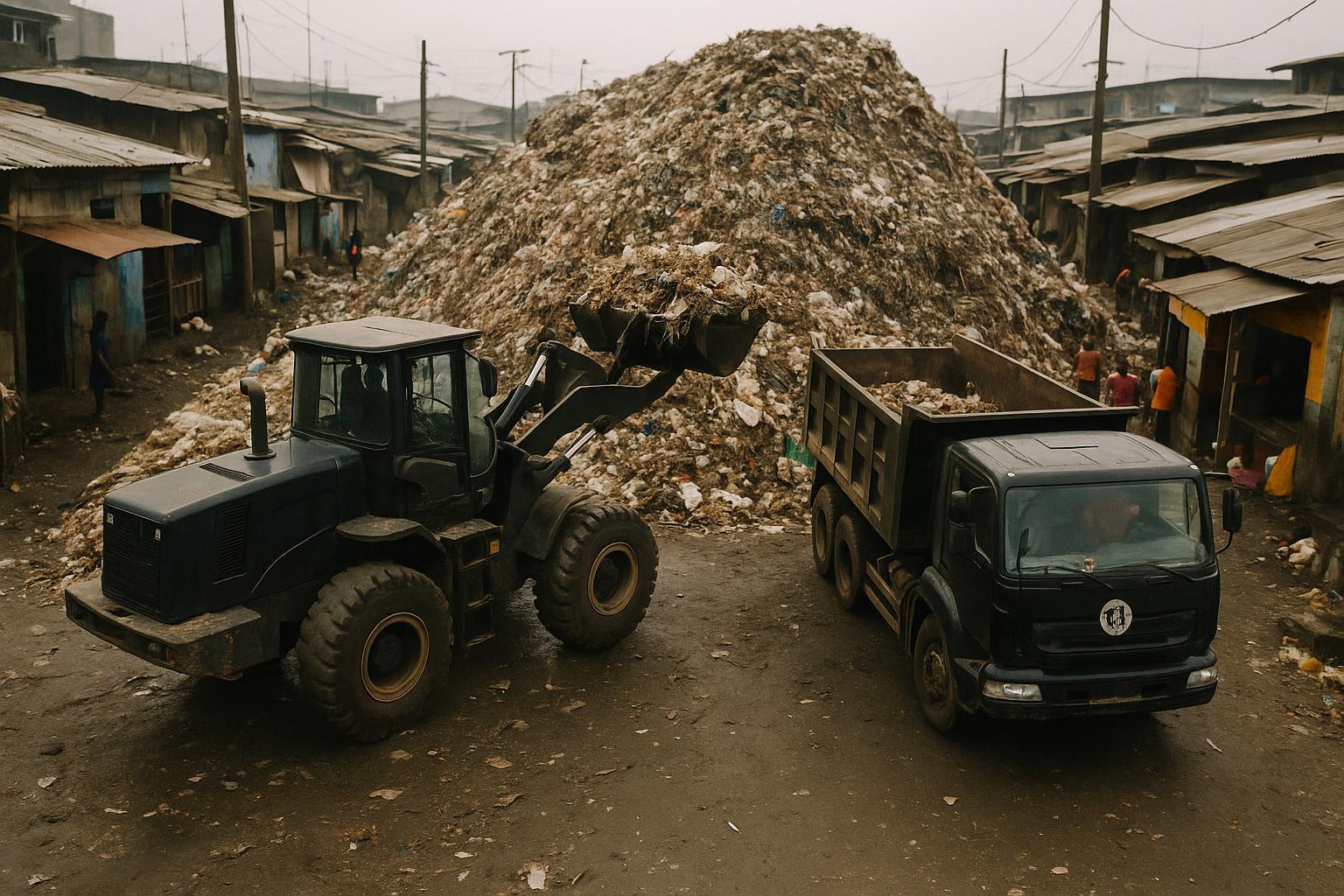
DGFE troops arrive for urban sanitation offensive
A convoy of khaki trucks rolled before dawn into Pointe-Noire, signalling the arrival of the General Directorate of Finance and Equipment’s sanitation unit, the team that recently stunned Brazzaville by erasing refuse mountains. Residents woke to uniforms, loaders and a promise: cleaner streets within days.
The deployment meets an instruction set personally by President Denis Sassou Nguesso, Supreme Commander of the Armed Forces, urging closer ties between security services and the population. For Colonel-Major Michel Innocent Peya, who leads the mission, waste removal is another front in defending the nation’s well-being.
Why the coastal capital needed swift help
Pointe-Noire’s challenges mounted after the sudden halt of the private operator Averda, whose trucks once criss-crossed the coastal city. Without specialised equipment, municipal crews struggled, and impromptu dumps mushroomed along busy avenues, around schools and behind market stalls, threatening commerce, tourism and public health.
Local authorities acknowledged the crisis as rains intensified, carrying debris into gutters and pushing floodwater toward homes. In Tié-Tié and Loandjili, respiratory complaints climbed, traders complained of vermin, and doctors flagged rising diarrhoeal cases. Intervention, city hall insisted, had become a matter of urgency.
Heavy gear, rapid logistics and first results
Answering that call, the DGFE flew mechanics from Brazzaville to the coastal garrison, readied bulldozers, compactors and water tankers, then split personnel into rapid-reaction detachments. The logistical chain, honed during public-works assignments, allowed the first convoy to reach Liberté market less than twelve hours after confirmation.
At Liberté, previously hemmed by towering trash, operators formed a relay: loaders scooped, tipper trucks shuttled, and tankers hosed pavements. By mid-afternoon, stallholders rediscovered daylight and circulation. Some, relieved, handed chilled water to soldiers; others applauded when the final heap disappeared into a covered skip.
Colonel-Major Peya emphasised that beyond aesthetics, the aim is restoring urban flow. Blocked sidewalks hinder business, narrowed lanes slow ambulances and buses, and visitors judge investment potential at first glance. ‘Security includes allowing citizens to move freely and breathe easily,’ he told reporters on site.
Health shield during the rainy season
Health professionals echo the link. During rainy seasons, refuse heaps trap stagnant water where mosquitoes breed. Decaying organic matter attracts flies that spread cholera and typhoid. By removing potential vectors, the DGFE reduces caseloads that already stretch Pointe-Noire’s hospitals, explained Dr Mabika of Tié-Tié clinic.
Meteorologists predict above-average downpours through March, making the preventive aspect decisive. Clean drains speed runoff and limit flooding that can erode roadbeds. The sanitation unit therefore combines waste removal with ditch clearance, a step local engineers say will shave repair costs when the dry season returns.
Official praise and socio-economic ripples
Pointe-Noire’s mayoral office issued a communiqué thanking President Sassou Nguesso, Interior Minister Raymond Zéphyrin Mboulou and the DGFE for what it termed ‘an exemplary fusion of security and development’. Officials underlined that partnerships with disciplined forces can accelerate municipal modernisation without raising taxes on households.
Political analysts see the intervention as consistent with the government’s broader public-service reforms, which seek to leverage existing state capabilities. By using military logistics in civilian domains, ministries avoid parallel spending while reinforcing the perception of an administration attentive to everyday concerns of traders and commuters.
For field personnel, satisfaction comes in tangible piles removed. Sergeant Laurette Mavoungou, who supervises a three-truck crew, recounted children cheering as she manoeuvred a loader near Moukoukou school. ‘Our uniform usually means security checkpoints. Today it means fresh air,’ she said, adjusting a fluorescent vest speckled with dust.
The DGFE plans to maintain a rotation in Pointe-Noire for four weeks, targeting one arrondissement after another until regular municipal service recovers. Spare parts will be airlifted if necessary from Brazzaville’s central workshop, ensuring mechanical downtime remains minimal, according to logistical chief Captain Ngatsé.
Once the coastal city is stabilised, similar deployments could assist secondary towns where waste management firms have limited reach. Observers note that the DGFE’s modular approach—mixing engineering platoons, medical officers and civic educators—may become a template for future civil-military cooperation across the republic’s eleven departments.
Economic operators already feel benefits. Taxi driver Jonas Mbemba notices shorter rides as garbage no longer blocks cab turnarounds. ‘Two extra trips per shift mean more income,’ he says. Market wholesaler Mama Sita counts fewer spoiled vegetables because flies have declined, translating hygiene directly into household purchasing power.
Environmental groups welcome the clean-up yet urge residents to modify habits. Activist Cyril Kivouvou argues that without household sorting and punctual collection, mountains will reform. He supports introducing community bins and public education while applauding the state’s quick action that, he says, ‘creates the breathing space for change’.
For now, Pointe-Noire counts freshly washed pavements, clearer drains and a proximity with uniformed professionals that feels reassuring. Each sunrise reveals fewer plastic bags fluttering on palm fronds. If the momentum holds, the city’s next carnival may parade through boulevards defined less by refuse and more by rhythm.